
Essential Chimney Waterproofing Perth Amboy NJ: 2026 Guide for Old Bridge Residents
Masonry chimneys in Old Bridge and across Middlesex County absorb more water than most homeowners realize. Brick is porous by nature, and once moisture gets into the mortar joints and flue liner, the damage compounds fast especially through the freeze-thaw cycles that hit central New Jersey every winter between December and March. Chimney waterproofing Perth Amboy NJ is one of the most cost-effective repairs we perform, yet it’s also one of the most frequently delayed until the damage is already serious.
If you’ve noticed white staining on your chimney exterior, crumbling mortar joints, or a musty smell near your fireplace, water has already found a way in. What follows is a plain-spoken guide to understanding what proper chimney waterproofing involves and why skipping it carries real structural and safety risk.
A Call We Got From Old Bridge Last February
A homeowner on the south side of Old Bridge called us in February 2025 after noticing a dark stain spreading across the ceiling above their fireplace. They assumed the roof was leaking. When our technicians inspected the chimney, the actual problem was a combination of failed mortar joints and no waterproof sealant on the crown — water had been tracking down inside the masonry for at least two winters. The liner showed early spalling, and the firebox had hairline cracks beginning to form. A waterproofing application and crown repair resolved the issue; full liner replacement would have run two to three times the cost if they’d waited another season. That scenario plays out every spring across Old Bridge, Sayreville, and Laurence Harbor.
Before You Start: What to Check First
Waterproofing is a protective coating it is not a repair compound. Applying sealant over existing damage traps moisture inside the masonry and accelerates the very deterioration you’re trying to prevent. According to the Chimney Safety Institute of America (CSIA), any waterproofing treatment should only follow a thorough inspection and the completion of any needed structural repairs.
Before scheduling or attempting any waterproofing work, confirm the following:
- Mortar joints are intact and fully pointed — no gaps, voids, or crumbling sections
- The chimney crown is not cracked or missing sections
- The flashing at the roofline is sealed and properly lapped
- There is no active efflorescence (white mineral staining), which indicates current moisture intrusion
- A Level 1 chimney inspection, as defined by NFPA 211 (2026 edition), has been completed within the past twelve months
Our chimney inspection service covers all of these checkpoints before we recommend any waterproofing product or application.
Step 1 — Identify Where Water Is Actually Getting In
Water doesn’t always enter where you expect. Most homeowners assume the top of the chimney is the culprit, but in older homes throughout Edison, Colonia, and Old Bridge, the flashing is frequently the primary entry point. Have a technician trace the moisture path before anything else. Applying waterproofing to the brick while the flashing is compromised accomplishes nothing.
Step 2 — Complete All Masonry Repairs First
This cannot be overstated. Repointing deteriorated mortar joints, patching crown cracks, and replacing damaged bricks must happen before sealant touches the surface. NFPA 211 is clear that the chimney must be structurally sound before any maintenance coating is applied. Our chimney repair and repointing service handles this as a prerequisite step — we don’t offer waterproofing as a standalone application on chimneys that show active damage.
Step 3 — Choose a Vapor-Permeable Sealant, Not Paint or Concrete Sealer
This is where a lot of well-meaning DIY attempts go wrong. Standard masonry paint or concrete sealers trap water vapor inside the brick. Chimneys need a product that blocks liquid water from the outside while still allowing the masonry to breathe and release moisture from within. Products specifically formulated for chimney use — such as those meeting CSIA recommendations for vapor-permeable chimney waterproofing — are the appropriate choice. Hardware-store masonry sealers are generally not suitable and can void any warranty on new mortar work.
Step 4 — Prepare the Surface Properly
The chimney exterior must be clean and completely dry before application. In New Jersey’s climate, that typically means scheduling waterproofing work between late May and early October, when daytime temperatures are consistently above 50°F and there’s no rain forecast for 24 to 48 hours. Our teams working across Metuchen, Fords, and Avenel typically book this work from late spring through early fall for exactly that reason. Any dirt, biological growth, or old paint residue should be cleaned off first — a soft wash is usually sufficient; high-pressure washing can damage mortar joints and should be avoided.
Step 5 — Apply in Two Coats, Top to Bottom
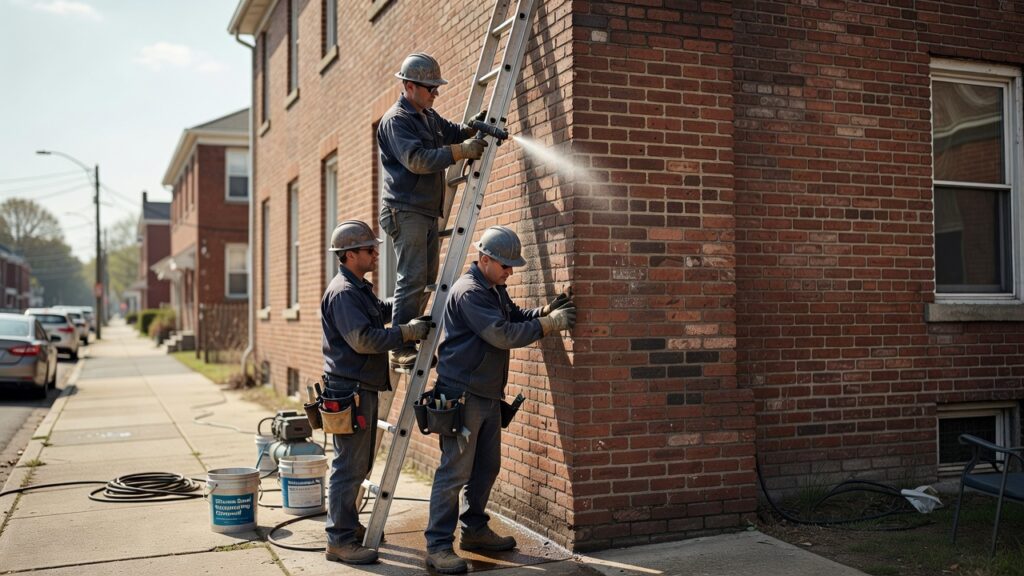
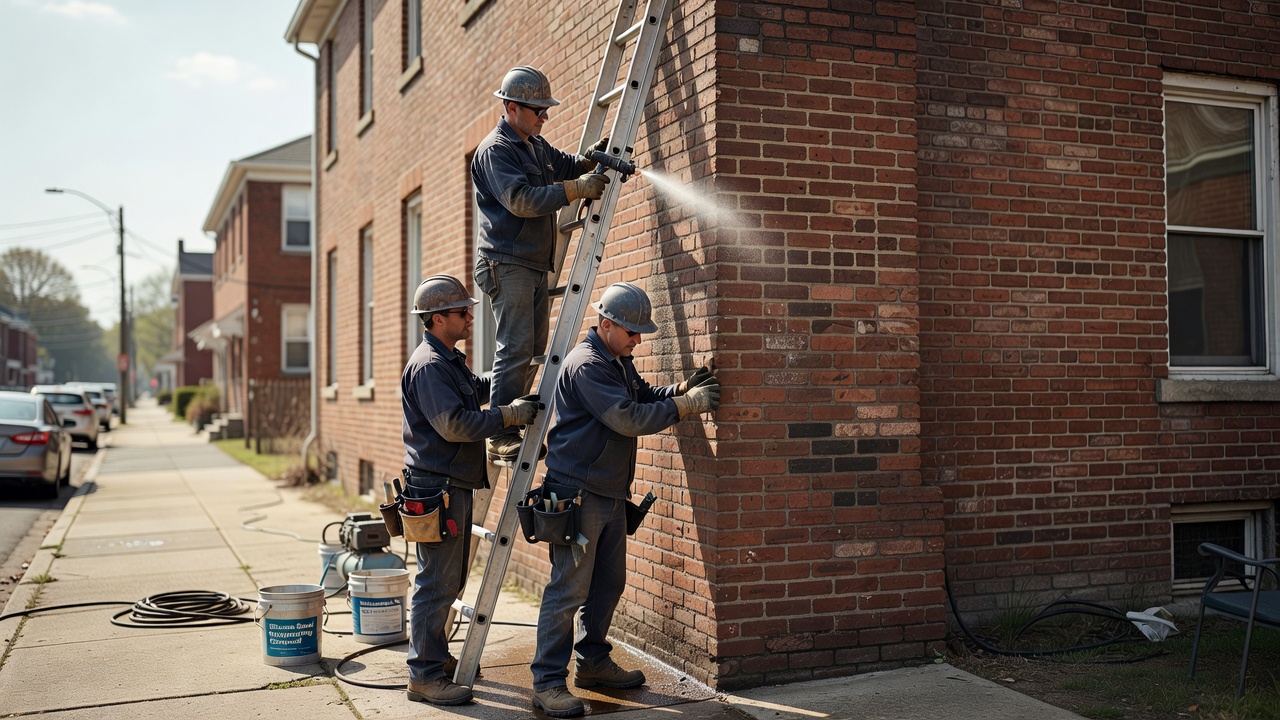
Proper chimney waterproofing Perth Amboy NJ professionals apply involves two saturating coats of vapor-permeable sealant, working from the top of the chimney down. The first coat is allowed to penetrate the masonry fully before the second coat goes on — typically a 20-to-30-minute window depending on temperature and porosity. Rushing this step leaves gaps in coverage at mortar joints, which are the most vulnerable points. Crown and flashing areas receive additional attention with a compatible crown coat or flashing sealant product.
Step 6 — Inspect the Cap and Chase Cover
While the sealant cures, it’s the right moment to evaluate the chimney cap condition. A properly fitted stainless steel cap keeps rain, animals, and debris out of the flue and a missing or rusted cap undoes even the best waterproofing application within a season or two. Our chimney caps and waterproofing service addresses both elements together. In Middlesex County, we see a lot of galvanized caps that have corroded on chimneys built in the 1970s and 1980s — Old Bridge has a significant number of homes from that era, and cap replacement is often part of the same service call.
Step 7 — Schedule a Follow-Up After the First Winter
Waterproofing is not a one-and-done application. According to the CSIA, chimney waterproofing treatments should be re-evaluated every five to ten years depending on product type and local conditions. New Jersey’s freeze-thaw cycles are harder on masonry than in milder climates, so we recommend a visual check after the first full winter to confirm the treatment is performing as expected. Any new efflorescence or mortar deterioration should prompt a call before the following heating season.
The Real Cost of Doing Nothing
Homeowners often postpone chimney waterproofing because it feels like a preventive expense rather than an urgent repair. The numbers tell a different story. A standard waterproofing application for a single-flue chimney in the Old Bridge area typically runs between $300 and $600 in 2026, depending on chimney height and condition. A full flue liner replacement the outcome of sustained water damage to the liner commonly runs $2,500 to $5,000 or more. Spalled brick replacement and full repointing on a deteriorated chimney can push past that. The math is straightforward.
Beyond cost, there is a safety dimension that matters more. A compromised liner caused by water damage increases the risk of carbon monoxide intrusion and chimney fire. NFPA 211 establishes liner integrity as a primary safety requirement, and water damage is one of the leading causes of liner failure in residential chimneys.
Troubleshooting Tip: Efflorescence Keeps Coming Back
If white mineral staining reappears on your chimney within weeks of cleaning, waterproofing alone will not fix it. Recurring efflorescence almost always means there is an active water entry point usually the crown, the flashing, or a missing cap that hasn’t been addressed. We see this regularly on service calls in Sewaren and Carteret, where salt air from the waterfront adds to the moisture load. The staining itself is harmless, but it’s a reliable indicator that water is still moving through the masonry. Treat the source, not the symptom.
Talk to Our Team Before the Next Rain Season
We serve Old Bridge, Perth Amboy, and the surrounding Middlesex County communities, and we’re straightforward about what work is actually needed we’re not going to recommend waterproofing on a chimney that first needs structural repairs, and we’re not going to oversell products that won’t solve the underlying problem. If you’d like an honest assessment of your chimney’s condition, reach out through our website contact form to schedule an inspection or request a free estimate. The earlier in the season you book, the more scheduling flexibility we have before the busy fall rush.
Frequently Asked Questions About Chimney Waterproofing in Old Bridge and Middlesex County
How do I know if my chimney actually needs waterproofing or just a cleaning?
Cleaning removes soot and creosote from the flue interior. Waterproofing treats the exterior masonry to prevent water absorption. They solve different problems. If you’re seeing white staining, spalling brick faces, or moisture inside your firebox after rain, waterproofing is likely part of what’s needed but a proper inspection should come first to confirm the scope.
Can I apply chimney waterproofing myself?
Technically, yes, but it carries real risk of making things worse. Using the wrong product particularly any non-vapor-permeable sealant traps moisture inside the masonry and accelerates deterioration. Working at roof height is also a significant safety hazard. For most homeowners in Old Bridge and surrounding areas, professional application is the safer and more reliable choice.
How long does chimney waterproofing last in New Jersey’s climate?
Most professional-grade, vapor-permeable chimney sealants are rated for five to ten years under normal conditions. New Jersey’s repeated winter freeze-thaw cycles are harder on masonry than in milder climates, so we generally suggest a visual inspection every few years and re-treatment closer to the five-year mark if the chimney sees heavy weather exposure.
Does chimney waterproofing cover the flashing too?
No. The flashing at the roofline is a separate system and requires its own sealant or replacement if it’s failing. Waterproofing the brick will not compensate for compromised flashing. Our technicians evaluate both during the same visit so nothing gets missed.
Is chimney waterproofing covered by homeowner’s insurance?
Preventive maintenance which is what waterproofing is is generally not covered by standard homeowner’s insurance policies. However, if water damage has already caused structural deterioration and it can be tied to a specific event, portions of the repair work may qualify for a claim. We recommend checking with your insurer directly. We can provide documentation of the damage we observe during inspection if that’s helpful.
What time of year should I schedule chimney waterproofing near Old Bridge?
Late spring through early fall is the best window ideally when daytime temperatures are consistently above 50°F and no rain is forecast for at least 48 hours after application. Trying to apply sealant in cold or wet conditions compromises adhesion and curing. We typically book this work from May through September for customers across Middlesex County.
Related from Perth Amboy Chimney: Finding a Trustworthy Chimney Sweep Near Me Perth Amboy · Honest Pricing for Chimney Sweep Perth Amboy NJ · Smart Chimney Inspection Woodbridge NJ